See what matters
DVT, intraoral scanning and digital impressions provide spatial information for a patient-specific plan.
Comprehensive implant dentistry · Berlin Mitte
Digital diagnostics, precise surgery, implant restorations and long-term aftercare from one coordinated team – with responsibility for the complete treatment pathway.
An implant is more than an artificial tooth root. Bone, gum tissue, bite, function and aesthetics are therefore considered together from the very beginning.
DVT, intraoral scanning and digital impressions provide spatial information for a patient-specific plan.
Gentle surgical techniques and clearly organised operating procedures give treatment structure.
Implant, restoration and aftercare are closely coordinated with our own CAD/CAM laboratory.
Everything from one team
At ZAK, diagnostics, implant placement, the final teeth and aftercare form one connected concept. Information, decisions and responsibility remain with the same team – without a gap between surgery and prosthetics.
Even years later, ZAK remains your contact for the complete restoration.3D diagnostics at ZAK
At ZAK, no implant is planned without prior DVT diagnostics. Digital volume tomography creates a three-dimensional dataset of the jaw region and reveals spatial relationships that cannot be represented completely in a two-dimensional X-ray.
Spatial assessment
For implant planning, the height, width and shape of the available bone and the position of sensitive anatomical structures can be decisive. Images can be viewed in freely selectable sectional planes and as a spatial reconstruction.
Digital · Ultra Low Dose
ZAK's radiography is fully digital and uses Ultra Low Dose certified technology. It enables three-dimensional imaging with dose-optimised protocols selected for the diagnostic task.
DVT is a standard part of every implant plan at ZAK. The field of view, resolution and protocol are nevertheless selected for the specific region and question, providing the exact dataset required for spatial planning.
The field of view and medical indication are determined after an individual examination. Radiation protection is guided, among other sources, by the German S2k guideline on dental digital volume tomography (AWMF 083-005).
Digital workflow
The 3D scan shows bone and anatomical structures. The intraoral scan records teeth, gum surfaces and the bite. Together with the intended restoration, they form the virtual implant plan.
Three-dimensional representation of bone and relevant anatomical structures.
Digital capture of the oral situation without conventional impression material where suitable.
Aligning the implant with both the available bone and the intended tooth position.
Design and manufacture of the restoration in direct coordination with the clinical team.
The virtual plan can be transferred to a custom surgical guide. It helps orient the planned direction and position during surgery. Whether such a guide is medically beneficial is assessed for each case; it does not replace surgical experience or intraoperative control.
Intraoral 3D scanning
A slim optical scanner records teeth, gum surfaces and the bite directly in the mouth. The three-dimensional model appears on screen during scanning and is then combined with the DVT and the prosthetic plan.
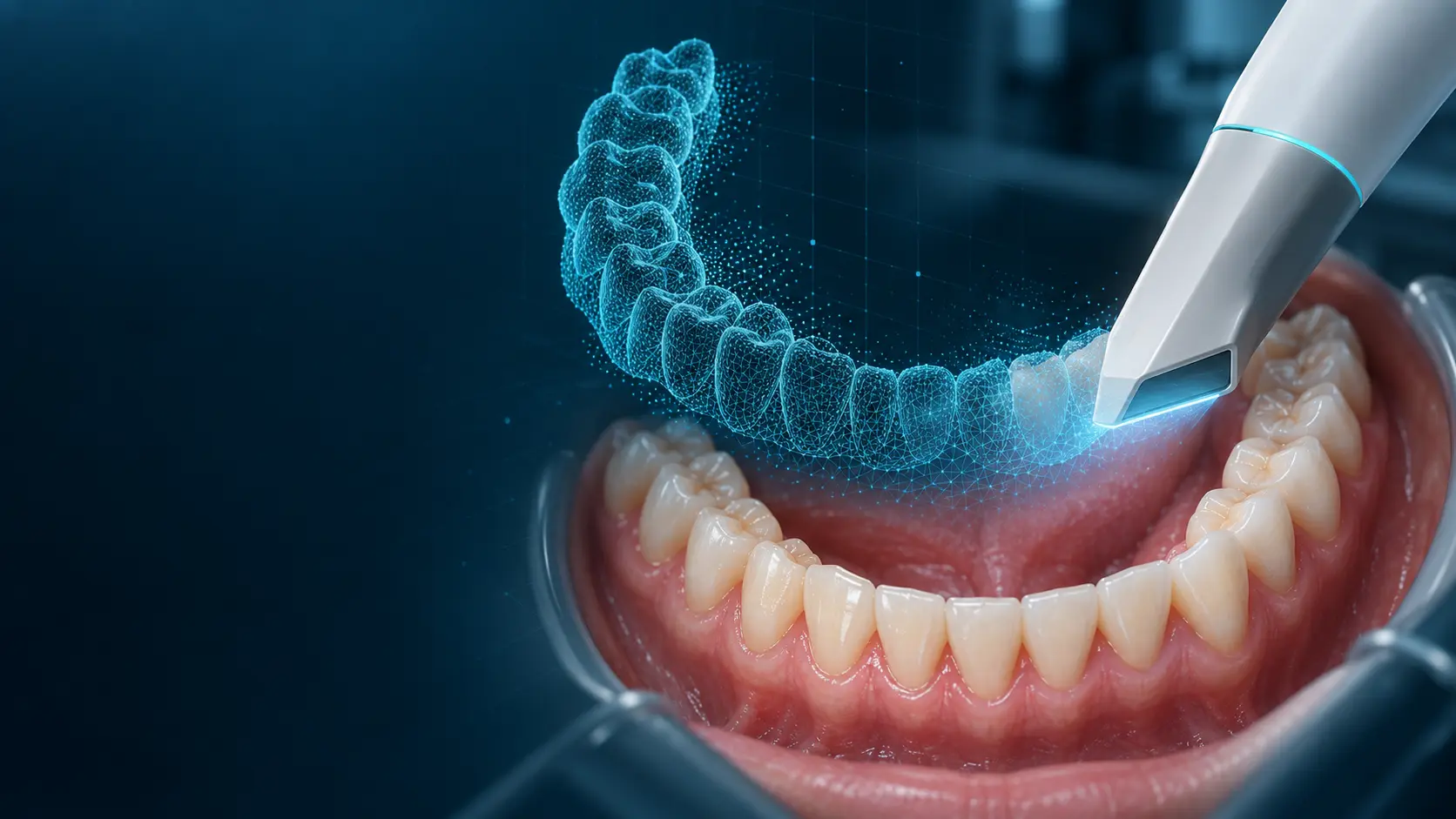 Optical · digital · radiation-free
What is an intraoral scan?
The scanner is guided across the dental arches. Cameras and light continuously record the visible surfaces while software assembles the information into a spatial model in real time. No X-ray radiation is produced.
What does it capture?
The scan represents visible structures in great detail. It cannot show bone, nerves or the maxillary sinus – that is the role of the DVT. The two datasets together provide the complete digital planning basis.
Why does it matter for implants?
The surface scan is combined with the DVT and the planned crown or bridge. Implant position can then be oriented to bone, safety distances, bite, aesthetics and future cleanability at the same time.
What does the patient experience?
Scanning can be performed in sections, paused and selectively supplemented. The finished model can be reviewed together immediately, making findings, planning and the future restoration easier to understand.
Prosthetic backward planning
The technically possible implant position alone should not determine the result. We first define where the final crown should sit for function, appearance and hygiene. Surgery and restoration are then planned backwards from that goal.
DVT: bone, nerve pathway, maxillary sinus and three-dimensional safety distances.
Intraoral scan: tooth shapes, soft tissue, contact points and bite relationship.
Virtual crown or bridge: position, shape, function, aesthetics and cleanability.
Implant dimensions and position; transfer via a surgical guide when appropriate.
Treatment spectrum
Whether one tooth is missing or a more comprehensive restoration is being considered, the key is a concept that brings medicine, function and aesthetics together.
Explore the full ZAK practiceReplace a missing tooth root without preparing healthy neighbouring teeth for a conventional bridge.
Fixed or removable solutions are planned around bone volume, bite and personal priorities.
If the available bone is insufficient, we assess regenerative options and the most appropriate individual pathway.
For extensive cases, we connect surgical planning, prosthetics, function and long-term maintenance.
In selected situations, a provisional restoration may be possible immediately or soon after surgery. Bone, primary stability, bite and the individual risk profile are decisive.
For dental anxiety or extensive procedures, we assess which support is medically appropriate – from local anaesthesia through nitrous oxide and sedation to general anaesthesia.
Treatment comfort & anaesthesia
Every person experiences treatment differently. ZAK therefore offers a spectrum from proven local anaesthesia through nitrous-oxide and medication-based sedation to treatment under general anaesthesia.

Safety before scheduling
Medical history, medication, existing conditions, procedure duration and personal preferences are assessed together. For sedation or general anaesthesia, you receive binding instructions about preparation, fasting, an accompanying adult and behaviour afterwards. These requirements vary by method and are discussed individually.
Medical framework: German Dental Association recommendations on sedation and outpatient general anaesthesia.
Our in-house CAD/CAM laboratory
Implant surgery and the final teeth are not separate worlds here. The digital dataset moves directly into design, while clinicians and laboratory coordinate shape, material, bite, fit and aesthetics without external detours.
for wet and dry processing of different dental materials
Scan, bite, implant position and intended restoration are assessed together.
Crowns, bridges, abutments or provisionals are created as three-dimensional designs.
Ceramics, zirconia or other suitable dental materials are milled according to the task.
Sintering, crystallisation, characterisation and glazing are matched to the material.
Fit, contact points, bite, aesthetics and cleanability are coordinated clinically.
Implant position and restoration affect each other. When design and treatment are closely connected, prosthetic requirements can be considered before surgery and later adjustments can be discussed directly with the clinical team.
Depending on the indication, we plan and manufacture implant-supported crowns and bridges, individual restorations, provisionals, models and other dental laboratory work. Material and production route are selected for the clinical task.
An implant restoration should not only look and function well on the day it is fitted. Transitions, spaces and contours must remain accessible for home care and professional review, so future maintenance is considered digitally from the outset.
Scans, photographs, designs and clinical feedback can be assessed together without long communication routes. This supports targeted corrections and keeps planning, manufacture and fitting within one closely connected team.
Core surgical team
Depending on the procedure, the team works together for professional exchange, clear processes and coordinated care.
Practice director · Implant dentistry
Supports the entire treatment pathway from diagnostics and digital planning through surgery, restoration and aftercare.
Continuously active in implant dentistry since 2006Dr Andreea Krauss is the founder and director of ZAK. Her implant work connects 3D diagnostics, surgical planning, bone and gum tissue, function, aesthetics and the final prosthetic restoration.
Implant dentistry · Surgery
Contributes many years of experience in complex implant dentistry, bone augmentation and sinus lift to shared planning and treatment.
Active in implant dentistry since 1995Prof Dr Ingo Voges is a permanent member of the surgical team and supports implant treatment alongside Dr Andreea Krauss – from operating plan through aftercare.
The four-eyes principle enables professional exchange, mutual control and a second experienced perspective during the procedure. Surgical and assisting roles can be assigned flexibly according to the situation.
A dedicated surgical assistant prepares instruments, implant components, regenerative materials, sterile workflows and documentation for the planned procedure, allowing the clinical team to focus on treatment.
The prosthetic target is considered before surgery. Our CAD/CAM laboratory coordinates design, material, fit, bite and aesthetics directly with the clinicians. Preventive care and regular reviews then support the implant over the long term.
Your path to an implant
We discuss your goals, medical history and existing records and examine your individual situation.
Imaging, scanning and the prosthetic target are combined into a clear treatment concept.
Surgery takes place in a structured setting, with local anaesthesia, sedation or general anaesthesia as appropriate.
After healing, the appropriate restoration is completed. We then remain responsible for reviews, preventive care and long-term support of the complete restoration.
Safety by design
For more extensive surgical treatments, team, sterile supplies, materials, technology and documentation are prepared specifically. Technical redundancy and clear responsibilities are part of this concept.
Designed from the ground up
ZAK was created across approximately 250 square metres from a completely empty shell. This allowed room routes, sterilisation, imaging, laboratory, climate control, ventilation, air filtration and technical services to be designed as one connected system.
On these days the treatment area is organised exclusively for surgical procedures. Other patients do not enter the clinical zone. Rooms, assistance, sterile supplies, materials, implant components, technology and aftercare are aligned with the scheduled operations, supporting calm and controlled workflows.
Clean and contaminated zones are separated spatially and organisationally. Used instruments follow a defined route through cleaning, disinfection, maintenance, packaging and sterilisation into protected storage, minimising cross-over between sterile and non-sterile items.
Instruments and sets are recorded with barcodes and assigned to the respective treatment. Thermal disinfectors, DAC, sealing units and sterilisers are integrated into digital documentation so releases, maintenance, validation, device tests and water quality remain traceable.
Air conditioning, ventilation, air flow and filtration were incorporated at the shell-planning stage. The technology supports a controlled and comfortable environment in treatment and surgical areas for patients and the clinical team.
Central services such as compressed air, suction and water treatment have redundant systems. Important practice functions therefore do not depend on one component alone; sterilisation and instrument processing are also technically and organisationally protected.
Treatment rooms, imaging, sterilisation, administration and laboratory are connected through a high-performance infrastructure. DVT, digital intraoral radiography, intraoral scanners and cameras supply data for diagnostics, planning, documentation and explanation. The CAD/CAM laboratory then handles design and production in-house.
Short internal routes, climate-controlled rooms, focused surgery days and personal support reduce organisational interruptions. Care remains clearly structured before, during and after surgery, including recovery, review and aftercare.
Frequently asked questions
These answers provide initial guidance. What is appropriate in your case can only be assessed reliably after a personal examination and review of your findings.
At ZAK, yes. We do not plan an implant without a prior DVT scan. The three-dimensional view of bone, nerves, the maxillary sinus and adjacent structures is a fixed safety basis of our implant planning. Field of view and protocol are selected individually.
There is no single universal value because dose depends on scan volume, resolution and protocol. ZAK uses fully digital, Ultra Low Dose certified radiography. For every implant plan, the field of view and settings are chosen to obtain the necessary 3D information with a dose-optimised protocol.
Augmentation may be required when the available bone cannot support an implant at the planned position and dimensions. Depending on the region and extent, different techniques may be considered, such as local augmentation or sinus lift. This can only be decided from individual findings.
Not automatically. A surgical guide can be useful for particular anatomical or prosthetic requirements. It is a planning and transfer tool with technical tolerances and does not replace surgical experience or ongoing control during the procedure.
Duration depends on the implant region, bone quality, any additional augmentation, primary stability and individual healing factors. A reliable timeline is therefore discussed only after examination and planning.
Alongside planning and execution, oral hygiene, healthy gums, regular reviews and professional maintenance are important. Smoking, untreated periodontitis, certain medical conditions or high mechanical loads can affect risk.
ZAK remains your contact for the complete treatment concept. Surgery, prosthetic design, fitting, reviews and professional aftercare are documented and coordinated by one team, so questions do not have to be passed between separate providers.
Costs depend on the initial situation, number of implants, potential bone augmentation, type of restoration and complexity. After diagnostics and planning, you receive an individual treatment and cost plan explaining the intended steps.
Treatment in Berlin
ZAK is located on the ground floor of Hotel Catalonia Berlin Mitte. For patients travelling from outside Berlin or from abroad, consultation, treatment, recovery and follow-up appointments can therefore be organised with particularly short distances.
BERLIN · MITTE
Köpenicker Straße 80–82 · 10179 Berlin
Heinrich-Heine-Straße
directly opposite
Central Berlin
close to Alexanderplatz, Museum Island and the historic centre
Short distances
practice, accommodation and recovery in one location
Existing X-rays, reports, medication lists and treatment plans can be sent in advance for initial orientation.
The final plan is made after a personal examination, our own DVT scan, an intraoral scan and a joint discussion at ZAK.
Appointments and treatment stages can be coordinated efficiently. The hotel in the same building avoids additional journeys after a procedure.
Reviews at ZAK are scheduled clearly; where appropriate, continuing care can be coordinated with a dentist close to your home.
Internationally accessible
All content is available in German, English, Romanian, Russian and Ukrainian. Personal support in your preferred language can be arranged in advance, subject to team availability.
The first step
Arrange your personal implant consultation in Berlin Mitte. You are welcome to bring or send existing X-rays and reports.